
But perfection has never been the standard by which I judge it.
I judge it by what it has allowed generations of Americans to accomplish.
For my family, the U.S. patent system has been more than a government office in Washington. It has been an institution that encouraged curiosity, rewarded hard work, protected innovation, and helped shape three generations of engineers.
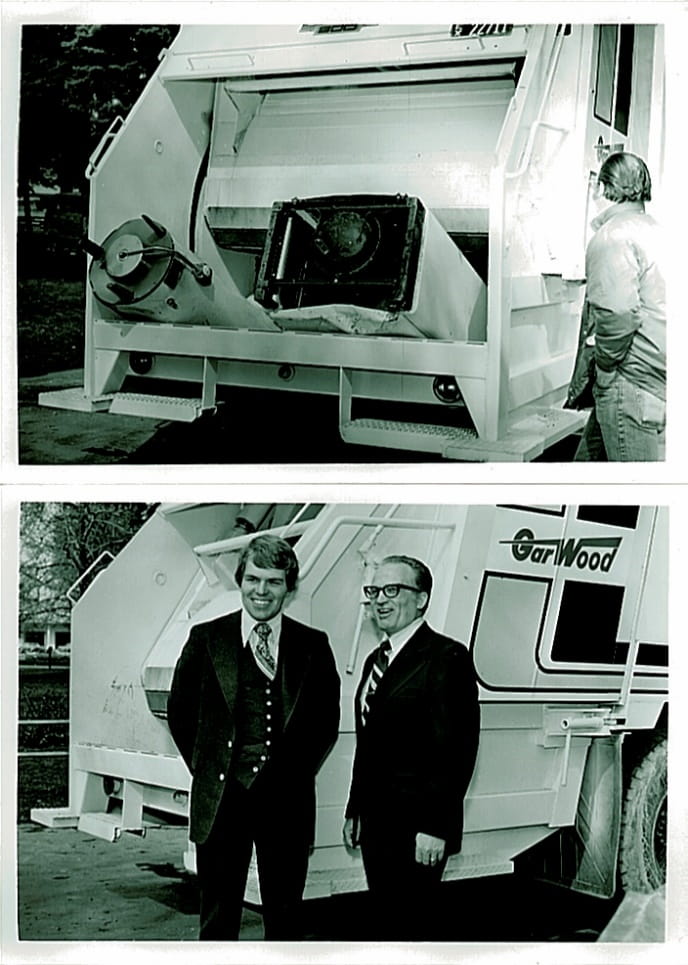
Fred T. Smith: From a Wyoming Farm to Refuse Collection Equipment
My grandfather, Fred T. Smith, grew up on a farm in Wyoming. Long before computer modeling and sophisticated design software, he learned to solve problems by working with farm equipment that simply had to work. He later served as an engineer during World War II after which he spent his career designing heavy equipment. His work touched excavators, trailers, trucking equipment, garbage trucks, and countless other machines that made difficult jobs easier.
One of his greatest contributions was the invention of a high-compaction rear-loading garbage truck that eventually became the foundation for what was sold as the Heil Formula 5000. He developed it as director of research and development at Garwood, a division of Sargent Industries, which Heil acquired in 1978. The design revolutionized refuse collection by allowing trucks to collect and compact far more waste before returning to the landfill, dramatically increasing productivity. The underlying packing mechanism became one of the defining innovations in the industry and influenced refuse collection vehicles around the world.
What Those Patents Made Possible
As refuse equipment continued to evolve, workers no longer had to lift countless heavy garbage cans by hand or ride on the back of moving trucks. The work became safer, more productive, and more dignified. Millions of people have benefited from these innovations without ever knowing the names of the engineers behind them.
That is the beauty of engineering. When we do our jobs well, the public notices the improvement, not necessarily the inventor.
Those patents and inventions also changed our family’s future.
They allowed my grandfather to establish his own consulting business. They opened doors to relationships with companies that became lifelong friends. They created opportunities that would eventually influence my father and, later, me.
Fred P. Smith and a Childhood Built Around Engineering
My father, Fred P. Smith, followed a similar path. Also a mechanical engineer, he has earned more than eighty patents across industries including trailers, garbage trucks, dump trucks, and exercise equipment. My father and grandfather worked together on refuse equipment for years, including patented compaction mechanisms for refuse and recyclables collection vehicles.
Growing up, I never realized how unusual my childhood was.
Our dinner conversations rarely involved politics. Instead, they revolved around science, mathematics, and engineering. One evening we debated whether the terminal velocity of a penny was greater than that of a human being. We constantly discussed better ways to solve problems. Curiosity wasn’t encouraged occasionally—it was simply part of everyday life.
Some of my earliest memories are tied to engineering.
The office was only a short distance from our home. As I got older, I mowed the lawn, cleaned the shop, and eventually began working alongside the engineers.
One of my mom’s favorite stories happened when I was still a toddler.
My mother decided it was time for me to give up my bottle. Around that same time, my father and grandfather were developing a prototype for what would become one of the first automated side-loading residential garbage trucks. After finishing my final bottle, I proudly threw it into the garbage can at the curb. Then I watched as the truck they were developing picked up the can, emptied it, and drove away with my bottle forever.
Apparently, engineering even solved my bottle habit.
Becoming the Third Generation
Eventually, I became the third generation of mechanical engineers in our family.
People sometimes assume that joining a family business means everything is handed to you. My experience was exactly the opposite.
I knew that most family businesses never survive into the third generation. That reality motivated me to prepare as thoroughly as I could. I graduated cum laude with a bachelor’s degree in mechanical engineering before earning both a Master of Science in Mechanical Engineering and an MBA. I wanted to understand not only how to invent products but also how to lead engineering organizations and develop successful businesses.
Today I hold seven patents of my own, most involving mobile equipment, continuing a tradition that began long before I was born.
One of my earliest patents was for a combination trailer capable of hauling aggregate to a job site and returning with palletized or packaged freight. By combining a watertight tarp system with a folding side wall that allowed loading equipment to reach into the trailer, it allowed one product to be hauled in one direction, and a second product to be hauled back. This eliminated the empty return trips many operators faced, increasing productivity and efficiency.
What Patent Litigation Taught Me About the System
Perhaps the greatest appreciation I have for the patent system, however, comes not as an inventor but as an expert witness.
Over the years I have worked on numerous patent disputes.
Some involve legitimate engineering efforts to design around existing patents, exactly as the patent system intends. Competition drives innovation, and companies should absolutely be encouraged to develop new solutions that respect existing intellectual property while creating something different.
Other cases are much less admirable.
In one case, I watched evidence emerge that a company’s executive had taken a patented product overseas, handed it to a manufacturer, and essentially asked them to copy it so he could sell it himself.
Without a patent system, the original inventor would have had little recourse. Years of creativity, engineering, testing, financial investment, and risk could have been erased by someone willing to copy rather than create.
Instead, the legal system recognized the inventor’s rights and required compensation for the theft.
Experiences like that have strengthened, not weakened, my confidence in the U.S. patent system.
Is it perfect? Of course not.
But after working inside patent litigation, I have found that the system generally works remarkably well. More often than not, the parties reach reasonable agreements. When courts become involved, I have personally been impressed by how carefully they work to understand highly technical issues before reaching a decision.
Why Patents Matter to People Who Build Things
They encourage people to try.
They encourage people to test.
They encourage people to create.
Every meaningful invention begins with uncertainty. Engineers spend thousands of hours solving problems that may never have obvious answers. They invest time, money, and often years of their lives pursuing ideas that might fail.
Knowing that a successful invention can be protected as intellectual property gives inventors confidence that their effort has value. It encourages them to take risks they might otherwise avoid.
That incentive has helped make the United States one of history’s great engines of innovation.
What We Inherited
My family’s story is only one example among countless others.
We did not inherit a fortune.
We inherited curiosity.
The U.S. patent system gave that curiosity an opportunity to become inventions, businesses, careers, friendships, and over two hundred patents spanning three generations.
For that, I am deeply grateful.
I hope my children and, someday, my grandchildren feel pride in that legacy, not because of the number of patents our family earned, but because each patent represents a willingness to solve a difficult problem and make someone else’s work a little safer, easier, or more productive.
I also hope they develop a lasting respect for intellectual property and a deep appreciation for a country that has long recognized the value of protecting ideas.
The U.S. patent system is not perfect.
Neither are the inventors who rely on it
But for generations of Americans willing to work hard, remain curious, and build something better than existed before, it has been one of our nation’s greatest gifts.
My family is living proof.
About the Author & Alpine Engineering
David Smith, MS, MBA, PE, CSP is President of Alpine Engineering & Design, Inc. He is a licensed Professional Engineer and a Certified Safety Professional, holds an M.S. in Mechanical Engineering and an MBA, and is named as an inventor on seven U.S. patents.
He has been retained as an expert in patent, product liability, and personal injury matters, and has testified in deposition and at trial in state and federal court. His technical focus includes refuse collection equipment, trailers and towing systems, heavy equipment, aerial lifts, forklifts, and conveyors. He also hosts The Expert Witness Podcast.
About Alpine Engineering & Design, Inc.
Alpine Engineering & Design is a mechanical engineering consulting firm specializing in product development, machine safety, risk assessment, and expert witness testimony. Our team of Licensed Professional Engineers (PE) and Certified Safety Professionals (CSP) are also named inventors, bringing firsthand experience with patent prosecution to claim construction, infringement, and invalidity analysis. To discuss a patent or intellectual property matter, product liability case, or engineering consultation, contact the Alpine engineering team today.