
Article By Brandon Conlin
“All materials are just really strong springs — some very long and elastic, some very short and stiff. Every thing is a spring.”
— an epiphany, recorded mid-lecture in Statics
* Later amended to “spring-mass-damper.” Let the record show the epiphany was not incorrect, merely incomplete. Further, I reserve the right to amend my opinions as new information is presented to me.
Disclaimer: What follows is a fun way to think about the physical world — one that’s especially handy for playful truss- and bridge-builder games. I highlight one I genuinely love, but I’m in no way affiliated with its creators.
Everybody take a deep breath and hold it. Remember back when everything made sense? Remember equilibrium? Okay — let it out. Ah. Here we are, back in the cool, calm world of statics, where everything pushes and pulls in equal measure.
Opposition sits in perfect balance. ☯
If you know what you’re doing, no part of the structure is unloaded: every member (an individual structural component, like a beam, strut, rod, or tie) serves a purpose and shares the load of the whole. Understanding how each member carries its load — and how it fails when it can’t — is the foundation of structural analysis, failure investigation, and sound engineering design.
There Is Elegance in Statics
There is real elegance in statics, and modern airport and stadium architecture is the proof. Those soaring roofs aren’t holding themselves up by magic — they’re a conversation between members in tension and members in compression. Let’s learn to speak their language.
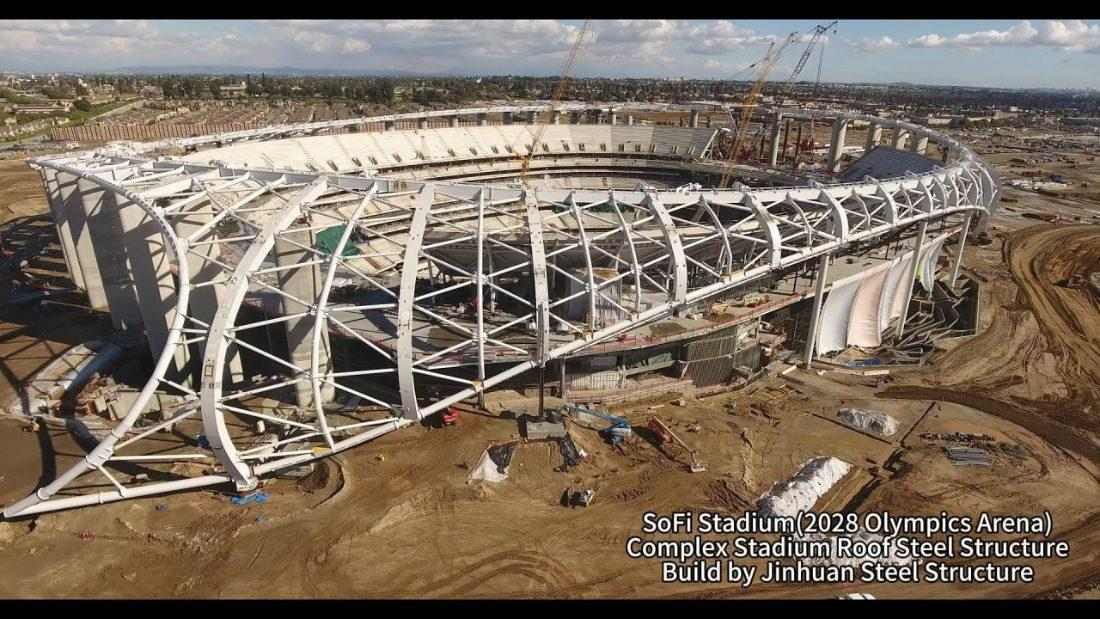
01 — Complex, wave-like geometry of the Sofi Stadium roof lattice
A Two-Party System: Tension vs. Compression Members
Every truss (an assembly of connected members forming a rigid framework, like in bridges or roof supports) runs on two parties: tension members and compression members. Tension members are being pulled apart. Compression members are being squeezed together. Master that single distinction and you’ve understood most of what a structure is doing under load.
Tension Members
Picture a trampoline spring. It’s designed to carry tension, so it can afford to be long and skinny. Try to compress it and it buckles instantly — but in tension it’s magnificent, capable of carrying high loads at high deflection. So what happens if you land hard and stretch one past its limit? It stretches out… and stays stretched out.

[Source]
02 — A trampoline spring stretched past its yield point
In engineering, when something deforms and does not return to its original shape, we say the material has yielded. The yield strength is the load at which a spring reaches the limit of its springy-ness (its elasticity), stops deforming elastically and begins to deform plastically. There’s some spring-back, but it will never return to its original shape — and, as the sad trampoline spring shows, it will never perform the same again either.
You’ve likely run this experiment yourself with a paperclip. Bend it once and you can never quite straighten it out again. Keep bending it in the same spot and it work-hardens, growing stiffer and more brittle until it snaps clean in two. It’s easy to see why engineers call that failure.

03 — Once disturbed, the paperclip never returns to its original shape
Examples of tension springs are everywhere: rope, rods, rebar, and structural shapes loaded in tension — and bolts.

[Source]
04 — Roof supports with tension members highlighted. Portland Airport (PDX)
Bolts? Oh yes. A bolt is a very strong spring. Tightening a nut is just like stretching that trampoline spring as you hook the mat — only far easier. Whether you preload it to a torque spec or simply crank on it with everything you’ve got, the length of bolt between the nut and the head is acting as a spring, clamping the joint together in tension.
Fastener failures — from insufficient preload, over-torquing, or cyclic loading that pushes the bolt past yield — are among the most common root causes in mechanical product failures and product liability claims.

[Source]
05 — A preloaded bolt behaves as a stiff tension spring
Compression Members
Now find the little compression spring inside a retractable pen — everyone has taken one apart at some point (right?). Before you use it to launch something across the room, play with the spring itself. Try to compress it down to its solid length, where every coil touches. Just before you get there, you’ll notice it takes real attention to keep the spring from shooting sideways out from between your fingers. It feels exactly like pushing two like poles of a magnet together, doesn’t it?

06 — A pen’s compression spring resisting solid length
That tendency to get squirrelly and deform off-axis has a name: buckling. Slender compression members almost always fail this way. As the load climbs, instead of staying straight and getting squished along its axis, the member bows out sideways to relieve the stress the loading has induced.
Buckling is a recurring issue in structural failure investigations and product defect cases — a slender column can appear completely undamaged right up until it doesn’t. The critical load depends on geometry, material, and end conditions that a visual inspection alone cannot reveal.
Examples of compression springs: columns, concrete, structural shapes loaded in compression — and the humble Capri Sun straw, which buckles instead of piercing the pouch at the worst possible moment.

[Source]
07 — The classic buckling failure of childhood, cruelly reimagined
There’s plenty more to the spring story, but we’ve come far enough to play a game. Truss me: you’re going to love it.
Truss Me — Where Springs Become a Game
Truss Me! is a structural simulator that lets you design your own trusses and watch them succeed or fail under load. Its goal is disarmingly simple: help you build intuition for how structures behave. Under the hood it’s anything but. The algorithms were designed by Dr. Julian J. Rimoli, an aerospace-engineering professor who specializes in computer models that predict how materials and structures fail.
It’s built on finite-strain theory and handles the things textbook problems usually ignore:
- Material nonlinearity (every member is elastic-plastic, yielding just like our trampoline spring)
- Geometric nonlinearity (the response is computed on the deformed shape, not the pristine one)
- Dynamic failure
- Members in tension fail once they reach a critical plastic stretch
- Members in compression fail by buckling
In other words, the game already knows everything we just said about springs.
Truss Me Crash Course*
*Before we begin, you can download Truss Me! at the Apple Store
Truss Me speaks in color. Tension members glow red. Compression members glow blue. You start with a simple challenge…

07 — Truss Me Challenge #1: red is tension, blue is compression
…and end with complete madness.

08 — Challenge # 24: What???
BUILDING A TRUSS: The blue dot button on the bottom left is for adding connections (nodes) and the bar button to its right is for adding structural members to connect everything together. Increase and decrease member size using the buttons whose icons are arrows point toward and away from structural members.
button to switch into ‘erase mode’ and select the members you’d like to remove. If you want to start from scratch, hit the broom button at the top center to nuke everything on the screen.
When you get a structure built, press play ▶️ (BOTTOM RIGHT) to load it.
OPTIMIZING A TRUSS: Every member you add increases the Structure Mass (TOP LEFT). Light-colored members are barely working, so size them down until they turn dark and fully loaded. Then design out every member you can while keeping the structure standing. The goal is the most efficient structure possible.

09 — Iterating toward a leaner, fully-loaded truss
Your design is graded on a scale of zero to three golden nuts — the more efficient the truss, the more nuts you get — with a numerical score and bar graph for finer resolution.

10 — A full bar and three golden nuts: a job well done
HONEST REVIEW: If you’ve read this far, go download Truss Me. The game is approachable but genuinely hard to master. You can chip away at an idea, wander off to another challenge, and return days later with fresh eyes. For me, that’s the entire design process in a nutshell — packaged as a truss simulator. And the best part: when your structure fails, there’s no liability, and no client betting on your design. You’re free to chase structures you’d never dare attempt in the real world.
Download Truss Me — App Store
Real-World Application
Truss Me doubles as a sandbox. Drop an approximation of a real-world load case into Freestyle Mode and you can test preliminary ideas in minutes — a graphical, back-of-thenapkin calculator for structures.
Disclaimer: Truss Me encourages designing right up to a factor of safety of 1 — the ultimate strength of the material. That is emphatically not how competent engineers operate. We design with a factor of safety appropriate to the application, and that factor scales with the risk to human life. Enjoy the game; don’t ship it.
When the problem is real, the analysis needs to be, too. Alpine Engineering provides structural analysis, failure analysis, finite element analysis, design review, and engineering expert witness services for manufacturers, product developers, attorneys, and insurers. We approach every engagement the way the game teaches: identify the springs, determine what each one is being asked to carry, and evaluate whether it can carry it safely
COMING SOON FROM ALPINE ENGINEERING & DESIGN
The AED Truss Me Challenge
Think you can build a better truss?
We’re putting together a one-off Truss Me challenge for engineers, structural-design nerds, and anyone else who gets a little too excited about load paths. Everyone will tackle the same challenge, then we’ll compare solutions to see who can build the leanest, smartest truss.
We’re still working out the details. Want the first crack at it when the challenge opens?
Notify Me When the Truss Me Challenge Opens
We’ll use your email to send you the challenge announcement. Newsletter signup is optional.
And yes, there will be a prize. We just haven’t decided how gloriously nerdy it should be yet.