
Article By Nathan Morrill, P.E., CSP
Why Trailer Safety Chains Matter
Alpine Engineering and Design has many years of experience in the design and analysis of trailers. One of the common issues we see is the proper use of safety chains.
When most people hook up a trailer, they barely give the safety chains a second thought. But those chains are a crucial line of defense. If the trailer ever comes off the ball, they are the only thing keeping it attached to your vehicle instead of allowing the trailer to become a runaway. A worn ball, a loose latch, or a forgotten coupler lock is just one bump away from turning a trailer into a large projectile on wheels. The chains are there to catch the tongue if that happens.
For a bumper-pull trailer, the chains should be properly rated, crossed beneath the tongue, and adjusted so they allow for turns without dragging while still being short enough to support the tongue if the coupler separates.
In this article we’ll cover what the law requires, the dangers of using chains improperly, how to evaluate your own chains, and how to set them up the right way.
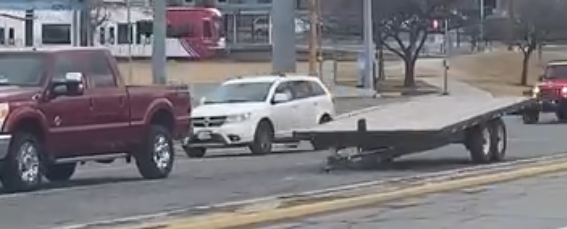
If a trailer separates from the hitch, properly configured safety chains are intended to keep it connected to the tow vehicle and help prevent the tongue from striking the roadway.
What Are Trailer Safety Chains Legally Required to Do?
Federal law requires that a tow vehicle have a safety device that keeps the trailer from breaking loose if it decouples (49 CFR § 393.70(d)).¹ Just as important, that device must be connected so the trailer’s tongue does not drop and hit the ground if a breakaway occurs, per FMCSA guidance.²
The basic purpose of the secondary connection is to keep the trailer attached and prevent the tongue from dropping to the road after a coupling failure.
On top of the federal rule, individual states add their own requirements. Many states specifically require chains as the connection device, some require the chains to cross underneath the tongue, and some require the chains to attach to the side of the tongue rather than the bottom.³
Because the details vary, check the requirements in your state and in any state through which the trailer will be towed.
Why Should Trailer Safety Chains Be Crossed?
Most of these laws exist for one reason: to make towing safe. Crossing the chains is what lets them meet the federal requirement to keep the tongue off the ground. When you cross the chains under the coupler, they form a cradle that catches the tongue if the trailer comes loose.⁴ ⁵

Properly crossed chains form a cradle under the coupler that catches the tongue before it can hit the road.
Here’s why that matters. If the tongue drops and strikes the road, it acts like a brake, suddenly slowing the rig and throwing both the tow vehicle and the trailer into erratic, hard-to-control motion. That can cause a crash and damage not just your vehicle and trailer, but other cars and property around you.
What Can Go Wrong With Improperly Used Safety Chains?
Attach to the Side, Not the Bottom
If a decoupling occurs and the tongue strikes the ground, it can land on the chains. The friction against the road grinds the chains down fast, much like using a grinder on the chains, and the connection can fail completely, releasing the trailer.
This is why some states require the chains to attach to the side of the tongue. When chains are attached to the bottom of the tongue, a ground strike can land directly on the connection point and can cause a complete failure and a total loss of control. Attaching to the side keeps that connection out of the impact and grinding zone.
Fire From Dragging Chains
Chains that are longer than they need to be will sag and drag on the road. Steel dragging on pavement throws sparks, and you won’t always see or hear it from the cab.
Dragging trailer chains can create sparks capable of starting roadside fires in dry conditions.⁶ Dragging chains are recognized by transportation and fire agencies as a preventable cause of roadside wildfires.⁷
Lost Strength From Wear
Dragging does more than start fires. Every time a chain drags, it wears thinner.
A safety chain is only as strong as its most worn or damaged link.
Put that weakened chain under the sudden load of a breakaway trailer and it can fail, leaving you with an uncontrolled trailer and nothing holding it back.

Inspect safety chain links for wear, gouging, deformation, and significant corrosion. Damage to a single link can compromise the chain.
Chains are also rated to SAE J684 design requirements.⁸ One chain is required to be able to support the total weight of the trailer. The chains are your last line of defense that can save you and others.

The chains are your last line of defense. When everything else fails, they’re what stands between an incident and a catastrophe.
How to Inspect Trailer Safety Chains
Before you trust your chains, evaluate three things: their condition, whether they have the right amount of slack for turning, and whether they can keep the tongue off the ground.
Start with condition. Inspect the links for wear, gouges, stretching, deformation, or rust. Wear most often comes from chains that are too long and drag during travel. If a chain shows real wear, replace it.
Chains vs. Cables
It’s also worth knowing the two most common connection devices on bumper-pull trailers are chains and cables.
Cables are designed as self-coiling springs that hold themselves up off the ground and resist wear while you travel.

Self-coiling safety cables help stay off the road during normal towing, but they hold hidden danger.
The trouble is that most cables are longer than they need to be, and in an actual decoupling they won’t keep the tongue off the ground, which puts you right back into the dangers above. Once a cable does drop to the road under the tongue, it grinds through in seconds and stops providing any secondary connection at all. Additionally, if water gets in the plastic housing around the cable, say for boat trailers, the water causes the cables to rust and deteriorate.
Based on my experience with bumper-pull trailers, properly sized and crossed chains are generally the best option.
How to Set Up Trailer Safety Chains Correctly
Once you’ve confirmed the links are in good shape, here’s how to set the chains up.
Cross the chains under the tongue, hooking each chain to the tow vehicle on the opposite side from where it starts. The crossed chains should have enough slack that the tongue never touches them during a turn, but not so much slack that they drag or allow the trailer tongue to reach the ground in a decoupling.
You can check this without even hitching up. Cross the chains properly, leave the tongue unhitched, and slowly lower it until the chains take the weight.
If the crossed chains catch and support the tongue, holding it off the ground, your slack is set correctly. If the tongue or chains touch the ground, you will need to adjust the length of the chains.
How to Take Up Extra Safety Chain Length
There are several options to adjust the length of a chain:
- Remove links from the chain to shorten its length.
- Move the hook back along the chain to take up slack.
- Run the chain through the tow vehicle’s eyelet and connect it back onto itself.
- Add a chain-adjustment device, such as a Link Lock, to the trailer.
Why You Shouldn't Twist Trailer Safety Chains
Some operators twist the chains to take up excess slack, but twisting is not a recommended adjustment method.⁴ When chains are twisted the strength of the chains can be reduced by as much as 60% leading to failed chains during a decoupling. This makes twisting the chains an unsafe option for chain take up.

Excess chain length should be corrected without allowing the chains to drag or relying on repeated twisting to shorten them.
Whatever method you choose to adjust chain length, keep the load-bearing portion of the chain pulling as straight as possible. Avoid twists, knots, and kinks, which concentrate stress and weaken the chain.
Bumper-Pull Trailer Safety Chain Setup

Cross the chains beneath the tongue and connect each chain to the opposite attachment point on the tow vehicle. Leave enough slack for the trailer to turn normally, but not enough for the chains to drag or for the tongue to reach the road if the coupler separates.
Trailer Safety Chain Pre-Trip Checklist
- Chains crossed under the tongue, with the right slack so they never drag.
- Tongue properly locked onto the ball.
- Electrical connection plugged in.
- All lights working.
Then you’re ready for safe travels.
About the Author
Nathan Morrill, P.E., CSP, is an Engineering Project Manager at Alpine Engineering & Design with more than two decades of engineering experience. He is a licensed Professional Engineer in five states and a Certified Safety Professional. His work includes product development, equipment safety, testing, engineering analysis, and the design and analysis of custom trailers and towing-related systems.
Nathan is also a named inventor on 12 issued U.S. patents and provides expert witness services in product liability and patent matters.
About Alpine Engineering & Design
Alpine Engineering & Design provides expert witness services, mechanical engineering, product design, and equipment safety for complex mechanical systems and equipment. Alpine’s engineers have experience designing, testing, and analyzing trailers and towing systems, as well as investigating equipment failures and accidents involving mechanical products.
The firm’s team includes licensed Professional Engineers and Certified Safety Professionals who work with manufacturers, businesses, attorneys, and insurers on both proactive engineering projects and forensic investigations.
References
- 49 CFR § 393.70(d), Coupling Devices and Towing Methods, Electronic Code of Federal Regulations.
- Federal Motor Carrier Safety Administration, regulatory guidance on § 393.70(d): the safety device must be connected so the tow-bar cannot drop to the ground if it fails or disconnects.
- Smith, Smith & Orr (Alpine Engineering & Design), An Engineering Guide for Trailer Safety Chain Installation, Attachment and Use: survey of state safety-chain laws, including the number of chains, crossing, and side-of-tongue attachment requirements.
- Purdue Extension, Keep the Trailer Connected to the Truck
- Equal-i-zer Hitch, How to Keep Trailer Chains From Dragging: crossing forms a cradle; proper slack.
- Arizona Department of Transportation, No sparks: Tow chains, underinflated tires can cause wildfires
- AAA/KMVT, AAA reminds dragging trailer chains can spark fires
- SAE J684, Trailer Couplings, Hitches, and Safety Chains, Automotive Type