
Article By Loren Sackett, PE, CSP
Every few months, headlines declare that a common everyday ingredient “can kill you.” Aspartame, the artificial sweetener found in diet sodas, is a prime example. Technically, the claim is true: aspartame has a lethal dose. But so does caffeine, so does salt, and so does water.
That last one isn’t a rhetorical trick. That’s the whole point. Understanding why water can kill you is the difference between a scary headline and an actual assessment of danger. It illustrates a foundational concept in safety engineering, whether applied to product design, industrial equipment, or forensic failure analysis: the distinction between a hazard and a risk.
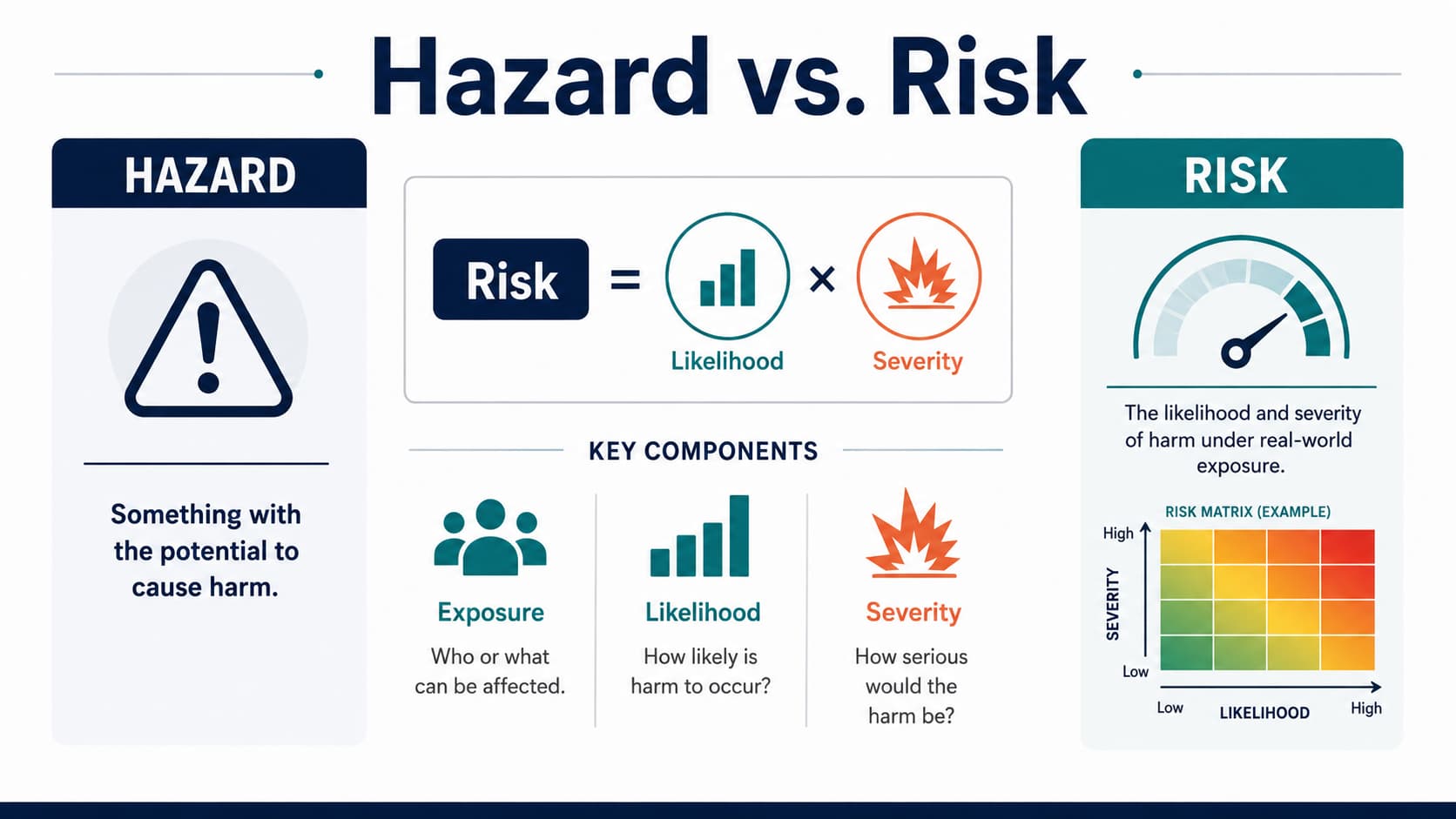
What is a Hazard in Safety Engineering?
Key Definition: A hazard is an inherent property of a substance, machine, or environment that has the potential to cause harm, regardless of how likely that harm is to occur.
A cliff edge is a hazard. Electricity is a hazard. Heavy rotating equipment is a hazard. Aspartame, because it possesses a dose at which it becomes lethal, is also a hazard.
Crucially, “hazard” says nothing about how likely you are to actually be harmed. It only says harm is possible. Nearly everything in the physical world can be a hazard under specific conditions, which is why hazard identification alone can be a terrible basis for product and machinery design, workplace safety, or product liability decisions.
How Engineers & Legal Professionals Define Risk
While hazard describes potential harm, risk measures real-world exposure and impact. In formal risk assessments, failure analysis, and litigation support, risk is evaluated through two primary definitions:
- Definition 1: Risk as Probability — Risk represents the likelihood that harm will occur. Under this view, risk answers one question: “What are the chances?”
- Definition 2: Risk as Probability × Severity — Risk is the likelihood of harm multiplied by the severity of the consequence (risk = probability × severity).
Risk = Probability x Severity
This two-variable model is embedded in most standard engineering risk matrices (such as ANSI B11.0 and ISO 12100) and formal risk assessments. A rare-but-catastrophic event and a frequent-but-trivial one can carry the same risk score. Evaluating both variables helps prevent two common mistakes: over-engineering against benign hazards and overlooking rare, high-consequence events.
Two Definitions of Risk
The two definitions aren’t contradictory; they’re the same idea at different resolutions. Definition 1 is a component of Definition 2. Probability alone tells you how often; multiplying by severity tells you how much it matters. For any serious assessment, the probability-times-severity model is the working standard, because a hazard you’ll never realistically encounter and a hazard that would kill you are not equivalent just because both are “unlikely.”
Hazard vs. Risk: A Toxicity Comparison
To understand how probability and exposure transform hazard into risk, let’s suppose you sat down to drink diet soda until the aspartame killed you. Using the published median lethal dose (LD50) values—the dose required to prove lethal to 50% of a test population—for a 70 kg (154 lb) adult:
| Compound | Published LD50 Value | Amount Required for Lethal Dose | How Many 12 oz Cans You Would Need to Consume |
|---|---|---|---|
| Aspartame | ~10,000 mg/kg |
~700 grams |
~3,500 cans of diet soda |
| Water | ~90,000 mg/kg |
~6.3 liters |
~18 cans of water |
You may find it surprising that the water would kill you nearly 200 times sooner than the aspartame would. While the hazard of aspartame is real, the actual risk it presents at plausible exposure levels is dwarfed by the risk of the water holding it.
The Problems with Confusing Hazard and Risk in Engineering Design
Confusing a hazard with a risk can lead to flawed decision-making, whether in public health debates or industrial facility management. A substance being capable of harm (a hazard) is not evidence that it will cause harm under the actual conditions of exposure (the risk). The difference is important.
Consider how this distinction applies across different engineering disciplines:
- In Consumer Product Safety: High heat is an inherent, unremovable hazard of a space heater. A designer focusing solely on the hazard might conclude that the product is simply too dangerous to produce, or encase it in a massive, impractically thick shell that makes it unusable. A risk-focused safety engineer evaluates foreseeable use and implements targeted safeguards instead: a protective grill, a tip-over shutoff switch, and a thermal cutoff. These measures reduce the probability and severity of harm to an acceptable risk level without destroying the product’s function.
- In Industrial Machinery Safety: A high-speed rotating shaft is an inherent mechanical hazard. An engineer focusing exclusively on eliminating the hazard might demand that the entire line be slowed down to non-hazardous speeds or completely sealed off, paralyzing maintenance and operation. A risk-focused approach leaves the hazard intact but controls exposure by installing interlocked guarding, establishing Lockout/Tagout (LOTO) protocols, and enforcing clear operational clearances.
Ultimately, sound design and safety reviews are not about eliminating every conceivable hazard, which is impractical if not impossible. Instead, effective engineering focuses on evaluating exposure, understanding foreseeable use, and implementing layered safeguards to reduce overall risk to an acceptable level.
FAQs
What is a hazard?
A hazard is an inherent property, source, or condition that has the potential to cause harm. A hazard does not say how likely harm is; it only identifies that harm is possible.
What is a risk?
A risk is the likelihood of harm occurring, and in many engineering contexts it is evaluated as probability multiplied by severity. Risk reflects real-world exposure and consequences, not just the existence of a hazard.
What is the difference between a hazard and a risk?
A hazard is something with the potential to cause harm. Risk is the likelihood and severity of that harm actually occurring under real-world conditions of exposure and use.
How do engineers assess risk?
Engineers assess risk by looking at exposure, likelihood, severity, and safeguards. The goal is to understand not just whether harm is possible, but how likely it is and how serious it could be.
Why does the distinction between hazard and risk matter in safety engineering?
It keeps safety decisions grounded in reality. A hazard may exist, but risk depends on whether people are exposed to it and how effective the controls are.
Sources & References
- AAT Bioquest. Toxicity and Lethality (LD50) Data: Aspartame.
- AAT Bioquest. Toxicity and Lethality (LD50) Data: Water.
- Berlin Packaging. Standard Soda Can Dimensions & Capacities.
- Kendall Reagan Nutrition Center, Colorado State University. The Low-Down on Diet Drinks: How Much is Okay?
About the Author & Alpine Engineering
Loren Sackett, PE, is a Certified Safety Professional and Senior Safety Consultant at Alpine Engineering & Design. Loren specializes in industrial safety compliance, risk assessments, workplace hazard evaluations, and forensic failure analysis for complex mechanical systems.
About Alpine Engineering & Design, Inc.
Alpine Engineering & Design is a mechanical engineering consulting firm specializing in product development, machine safety, risk assessment, and expert witness testimony. Our team of Licensed Professional Engineers (PE) and Certified Safety Professionals (CSP) helps manufacturers, industrial facilities, and legal teams solve complex technical challenges and maintain compliance with OSHA, ANSI, and ISO standards. To discuss a machinery design review, safety assessment, or consultation, contact the Alpine engineering team today.