
Article By Nathan Macdonald
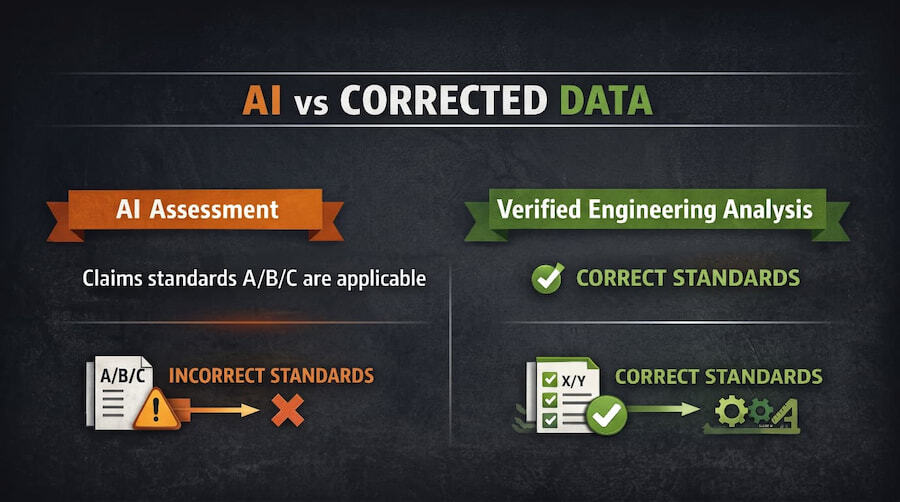
Executive Summary: In pre-litigation consulting, generative AI tools may construct persuasive yet fundamentally flawed liability claims. This case study details how an unverified LLM analysis misapplied ASTM F2291 safety standards to flawed accelerometer data during a roller coaster injury investigation and how human engineering judgment identified critical data collection and analysis errors before costly litigation began.
The Role of AI vs. Human Expertise in Pre-Litigation
Earlier this year, I was retained in a pre-litigation consulting role involving an alleged injury on a modern amusement park ride. The engagement never progressed to a lawsuit, and that outcome is precisely why the case is worth discussing.
This experience illustrates an increasingly common issue: artificial intelligence can sound authoritative while quietly missing context, misapplying standards, or reinforcing user bias. In contrast, a qualified human expert can ask uncomfortable questions, challenge assumptions, and apply standards as they were actually intended.
This article shares that story, carefully anonymized, not to criticize AI, but to clarify how it should (and should not) be used in technical and legal decision-making.
The Initial Claim: Relying on AI for Roller Coaster Injury Allegations
A private individual believed she was injured while riding a newly constructed roller coaster, completed in 2023. The ride was modern, relatively low in height and had a moderate top speed (around 50 mph). Public rider feedback consistently described the coaster with glowing remarks, as smooth.
After riding the attraction, the individual reported experiencing dizziness and ultimately underwent cervical spine surgery. She believed the injury resulted from:
- The speed and length of the ride
- A forward-leaning posture adopted to reach the restraint
- Repeated neck loading during the ride cycle
Before contacting me, she had extensive conversations with a well-known and widely used generative AI tool powered by a large language model (LLM), which repeatedly told her she had a strong legal case against the park.
Importantly, she herself had a technical background, which made the AI’s confident but flawed explanations especially persuasive. This was because her level of competency was high enough to know what the answer should look like overall, but not sufficient to actually evaluate the detailed merit of the answers she got back. AI provided answers that appeared clear and correct, but were actually incorrect for subtle but crucial reasons.
The First Technical Problem: Unverified Data Collection & Misapplied ASTM Standards
After these AI conversations, the individual had a third party covertly collect accelerometer data using a mobile device during the ride. That data was provided to me after I was retained.
The AI had already “analyzed” the data and concluded the ride exceeded allowable limits under ASTM F2291: Standard Practice for Design of Amusement Rides and Devices. This is the internationally recognized standard that establishes the specific design requirements and force limits for acceleration and vibration intended to ensure the physical safety of passengers on amusement rides and devices.
On further inspection, I found there were multiple issues with this conclusion.
Misapplying ASTM F2291: Using The Wrong Standard Year
The AI’s conclusion was fundamentally flawed because it applied a benchmark (specifically ASTM F2291-2024, an updated version of the standard published in 2024) that did not yet exist when the events occurred. Since the ride was completed and operated in 2023, the applicable standard was ASTM F2291-22 (the 2022 version).
In engineering and safety forensics, later revisions do not retroactively apply to existing machinery unless explicitly mandated by law. By measuring 2023 data against a 2024 rulebook, the AI missed a critical legal and technical distinction: you cannot be held to a standard that hasn’t been written yet.
Improper Accelerometer Methodology & Sensor Bias
The initial data collection suffered from several fundamental flaws:
- No proper fixturing:The device was not rigidly mounted.
- Unknown orientation: The sensor axes were uncalibrated and misaligned.
- Inadequate sampling rate: The 10 Hz sampling frequency was far too low for meaningful dynamic analysis.
- No appropriate signal filtering: There was an absence of a four-pole low-pass Butterworth filter with a 5 Hz cutoff, which is explicitly required for evaluating ride accelerations under ASTM standards.
In short, the data could not reliably represent the ride’s true acceleration environment. I advised that if meaningful conclusions were to be drawn, new data would need to be collected correctly.
Correcting the Analysis, and a Very Different Result
Improved accelerometer data was later collected with better methodology. I analyzed that data against the correct standard (ASTM F2291-2022).
The results were unambiguous:
- All measured accelerations were well within allowable limits
- The data confirmed compliance, rather than indicating a defect
- There was no evidence of abnormal dynamic behavior
Here you can see the original data showing unusually high acceleration spikes (which the generative AI tool communicated were highly problematic but would actually just be filtered out vibration under a standard 5Hz low pass filter).

Graph showing raw accelerometer data with high g-force noise spikes at 10Hz sampling rate and without the Butterworth filter.

Graph displaying filtered 200Hz accelerometer data alongside the ASTM patron coordinate system diagram.
This shows that while the previous data was assumed to have legitimate spikes on the order of 11g’s, properly collected data using the same accelerometer (but this time with the right fixturing and settings) showed no such spikes. Further, per the standard, the data has to be fed through a four pole low-pass Butterworth filter.
Shown above is the unfiltered data (orange) and the filtered data (blue). This allows acceleration-based decisions to rely on meaningful, sustained accelerations rather than stray vibration.
At this point, the technical question should have been settled.
But it wasn’t.
When Generative AI Keeps Moving the Goalposts in Legal Claims
Despite this analysis, the individual continued consulting the AI chatbot. Each time an argument fell apart, the AI suggested a new one.
Misapplying ISO Vibration Standards to Transient Events
The AI proposed ISO vibration exposure standards as a new theory of liability. These standards provide a method for evaluating human exposure to whole-body vibration containing multiple mechanical shocks. However, those standards address chronic, long-duration occupational exposure, not single, transient ride events.
They were simply not applicable to the alleged mechanism of injury.
Faulty Numerical Reasoning in Consumer Sensor Integration
The AI also suggested integrating acceleration data to reconstruct ride speed. This ignores:
- Sensor bias
- Drift
- Cumulative round-off error
Without extremely controlled instrumentation and correction techniques, such integration is not reliable, especially with consumer-grade sensors.
Again, this nuance was lost.
Unsubstantiated Claims of Gender Bias in Safety Standards
Finally, the AI suggested that ride standards might be unsafe for women because they were allegedly “written for men.”
There was no evidence provided to support this claim, nor was there data showing differential injury rates or design exclusions. The argument was speculative and unsupported, and would not survive expert scrutiny.
The Pre-Litigation Reality Check: Evaluating Case Viability
I ultimately explained the arguments she would need to overcome to prevail in a lawsuit, including that:
- The ride was designed in accordance with all applicable engineering standards
- Thousands of riders, men and women, had safely ridden the attraction
- Her own data confirmed compliance, rather than defect
- There was no reliable proof that the ride caused her injury, as opposed to other factors
- There was no evidence supporting claims of gender-based design exclusion
Based on the technical and evidentiary landscape, the case was not viable.
I recommended that she not pursue litigation.
She accepted that recommendation, and did not file suit.
Human Engineering Judgment vs. LLM Confidence
That hour likely saved the client tens of thousands of dollars, months (or years) of stress, and a deeply uncertain legal outcome.
The key takeaway is not that AI is useless, because it certainly has its place. AI can:
- Surface ideas
- Summarize standards
- Prompt questions worth exploring
But AI cannot replace expert judgment. It does not:
- Understand applicability
- Challenge assumptions
- Weigh evidence against legal burdens
- Recognize when data actually disproves a claim
Most importantly, AI tends to reinforce the user’s existing belief, rather than critically challenge it.
A human expert has an obligation to do the opposite.
Key Takeaways: Protecting Legal Teams from Flawed AI Claims
While it is deeply unfortunate that this individual suffered a serious injury and was searching for answers, it was good that this case never made it to court. Providing an honest technical assessment spared her from the added emotional and financial strain of a lawsuit built on a primary premise that could not be supported.
By applying engineering standards correctly, scrutinizing data quality, and asking hard questions, a clear and defensible conclusion emerged, one that an AI chat tool, despite its confidence, failed to reach.
AI is a powerful assistant.
But truth still requires judgment.
And judgment remains human responsibility.
Need an Objective Technical Opinion on Your Claim?
Whether early analysis seems to support your position or leaves critical questions unanswered, having an objective engineering evaluation ensures you are working with reliable facts. At Alpine Engineering, our licensed professional engineers bring decades of rigorous technical analysis to stress-test assumptions, evaluate complex data against accurate industry standards, and deliver clear, defensible conclusions, helping you understand the true strength of a claim before moving forward.
Contact Alpine Engineering today to speak with a forensic mechanical engineering expert about evaluating your technical evidence.