
For a startup or growing manufacturer, outside engineering can look like a line item to cut. In practice, it usually pays for itself. The decisions made during design lock in two outcomes that follow a product for its entire life: how likely it is to hurt someone, and how much it costs to build.
Outsourced engineering services means bringing in an engineering consultant, a licensed engineer or a small firm, for a defined scope of design, analysis, or review work instead of adding full-time staff. It is not the same as offshoring drafting labor. The value is senior judgment applied early, when changes are cheapest.
An experienced engineer can improve both outcomes before the first unit ships, through hazard analysis, safety factors, and material selection, when changes are cheapest. The same engineer can also take cost out of products already in production, where a small savings per unit multiplies across every one of your best sellers.
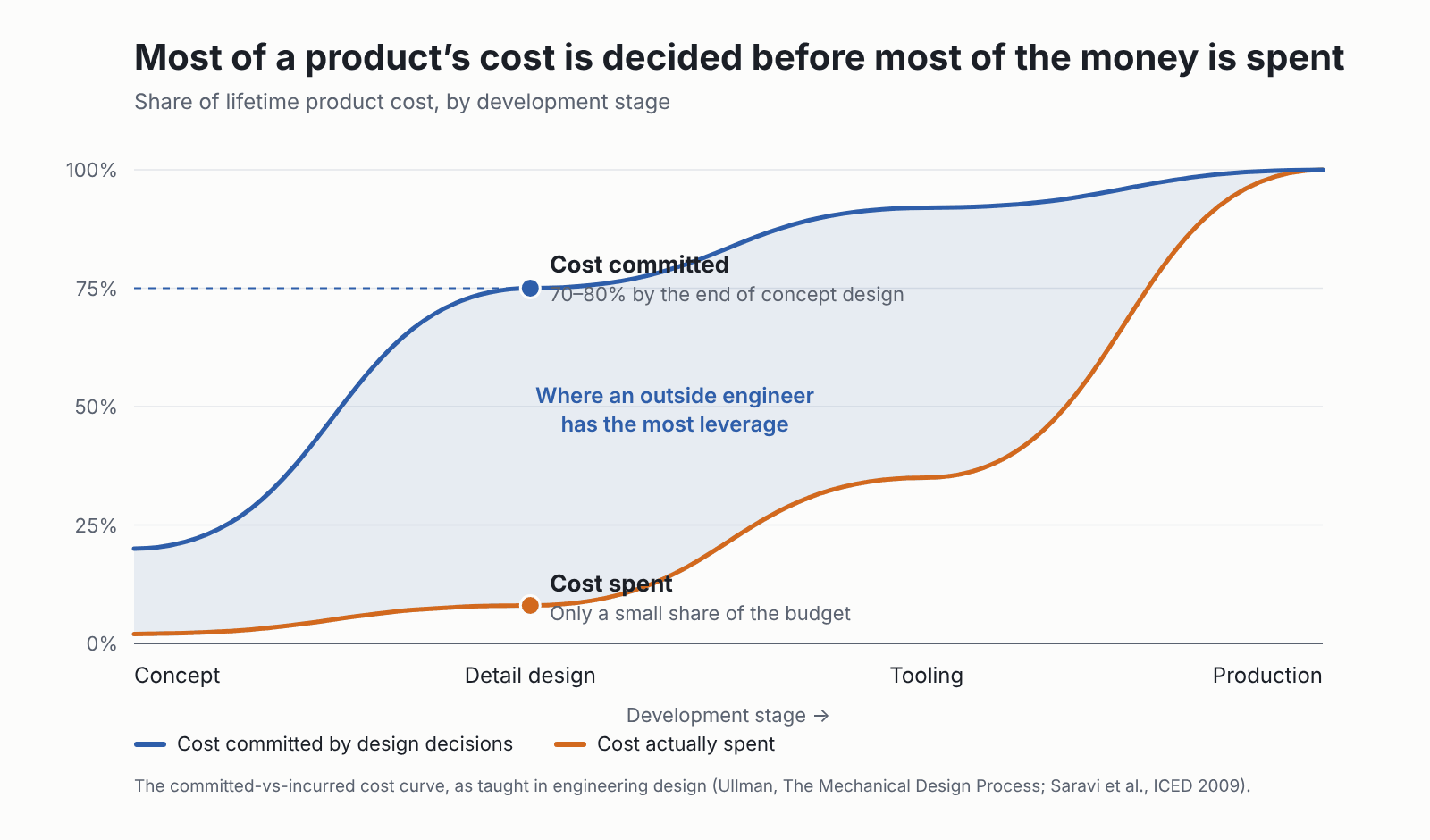
A standard figure in engineering design: most of a product’s lifetime cost is committed during concept design, before tooling is cut. That is the window where an engineering review pays back the most.
The Real Cost of Product Liability and Recalls
Product liability is where design shortcuts become expensive. In 2025, juries returned nearly 200 “nuclear verdicts” (awards of $10 million or more) against corporate defendants, totaling $25.6 billion, according to Marathon Strategies’ annual report. 1 Product liability was the largest category by a wide margin: $12 billion, nearly half of all nuclear-verdict dollars, from just 29 cases. When a product case reaches a jury, the awards are the largest of any category.
Those headlines often involve large corporations, but the trend matters even more to smaller companies. A single eight-figure verdict can exceed the liability coverage many small and mid-sized manufacturers carry. Even a case you win costs years of legal fees and management attention.
Those headlines often involve large corporations, but the trend matters even more to smaller comLarge verdicts grab headlines, but product liability costs extend well beyond the courtroom. The Consumer Product Safety Commission announced 420 recalls in 2025 covering more than 40 million units, the most in any year since 2007.2 Allianz’s analysis of recall insurance claims put the average cost of a significant recall at more than $12 million and found that a defective product or design was the leading cause. 3 Much of that cost arrives after the recall notice: stopped production, redesign, new tooling, and the claims that follow.
Marathon cites growing public mistrust of corporations as a major driver. That means juries are increasingly likely to ask one question: what did this company do to make its product safe? The strongest answer is a documented engineering process.
Hazard Analysis: Find the Problems Before Your Customers Do
A hazard analysis is a structured review of how a product could injure someone, completed before the product reaches the field. The engineer walks through every stage of the product’s life, from shipping and installation to operation, maintenance and disposal. At each stage, the question is what could go wrong, including reasonably foreseeable misuse.
Each hazard is rated for severity and likelihood, then addressed in order of effectiveness. Design the hazard out first. Guard against it second. Warn about it only when the first two options are not feasible.
For industrial equipment, recognized frameworks such as ISO 12100 (risk assessment for machinery) and ANSI B11.0 (the U.S. machinery safety standard) give this work structure, and the same thinking applies to consumer products.4,5 The result is a safer product, plus a paper trail showing that safety was engineered in from the start rather than bolted on after a complaint.
The timing matters as much as the method. A hazard found during design costs a drawing revision. The same hazard found in the field costs a recall, a redesign after tooling is cut, or an explanation to a jury of why no one looked.

The three-step method from ISO 12100: eliminate the hazard by design, guard what remains, and warn only about what can’t be guarded. Each step down the list costs less to apply and does less to protect.
Choosing a Safety Factor: Enough, But Not Too Much
A safety factor is the ratio between the load a part can carry before it fails and the highest load it is expected to see in service. A safety factor of 2 means the part can carry twice the expected peak load. Set it too low, and normal variation in loads, materials or manufacturing can push a part past its limit. That is how fatigue cracks, bent frames, and broken welds end up as evidence in a lawsuit.
Set it too high, and you pay for it on every unit you build. Overbuilt parts use more material, weigh more, need larger motors and cost more to ship. It is common to find designs where every dimension was simply increased “to be safe,” with no analysis behind the choice.
The right factor depends on how well the loads are understood, how consistent the material is, how severe a failure would be, and what applicable codes require. Getting it right takes both calculation and judgment.
How Material Selection Drives Cost and Performance
Material choice is one of the largest cost levers in any design. A long-standing finding in the engineering design literature, repeated in standard design texts, is that 70% to 80% of a product’s cost is committed by the end of the conceptual design stage (ICED 2009),6,7 and materials are a big part of that commitment.
A material decision affects far more than the price per pound. It determines which manufacturing processes are practical, whether parts need painting or plating, how much the product weighs, and how long it lasts in service. Typical savings come from using coated carbon steel instead of stainless in dry indoor environments, or redesigning a machined part so it can be formed or molded instead.
The reverse also happens. A material that looks cheap on paper can crack in cold weather or corrode in a washdown environment. An engineer weighs cost, strength, durability, weight, and availability together, so savings do not create a new failure mode.
Why Outsourced Engineering Services Make Sense for Growing Companies
Startups and mid-sized companies rarely need a full-time specialist in every discipline, and hiring one can take months. Outsourced engineering services give you that expertise when you need it, for a defined scope and budget. Some companies call this a fractional engineer. The arrangement is the same: senior expertise on a defined scope, without a hire.
An outside engineer also brings fresh eyes. A team that has lived with a design for a year can stop seeing its weak points. We review it the way a demanding customer, a regulator or a plaintiff eventually would. That is not a figure of speech: Alpine’s engineers also serve as expert witnesses in product liability cases, so we have seen which design decisions end up in front of a jury.
Most importantly, the cost is small compared with what it prevents. A design review costs a fraction of a recall, a redesign after tooling is cut, or a single lawsuit.
What you are paying for, in practical terms:
- Expertise on a defined scope and budget, not a salary line.
- Speed: the work starts in weeks, not after a months-long hire.
- Fresh eyes on a design your team may have stopped seeing clearly.
- A documented engineering process that a customer, regulator, or jury can read.
- A cost that is small next to a recall, a re-tool, or a claim.
When Outsourcing Engineering Makes Sense, and When It Doesn’t
Outsourced engineering makes sense when you are developing a new product and do not have an engineering team: concept, prototypes, testing, and drawings ready for manufacture, on a defined scope. It also makes sense when a product is headed for tooling or launch without an independent review; when you need a discipline you do not have on staff, such as hazard analysis, structural analysis, or materials; when a product already in production has margin or warranty problems; or when a customer, insurer, or regulator is asking for documentation you do not have. For a small company, it can be the ongoing engineering function: development as needed, without a hire the workload would not keep busy.
It makes less sense when there is enough engineering work to keep a full-time engineer busy yearround, or when the work needs someone at the bench or on the production floor every day. At that point, hire.
Frequently Asked Questions
What is engineering services outsourcing?
Engineering services outsourcing is hiring an outside engineer or engineering firm for a defined piece of work, such as new product development, prototyping, a design review, hazard analysis, or a redesign for cost. For most growing manufacturers it is used for specialized or occasional work where a full-time hire would sit idle.
What does an outsourced engineering consultant do?
A consulting engineer designs a product or reviews the engineering behind one: hazard analysis, safety factors and load calculations, material and process selection, drawings, testing, and documentation. The deliverable is a design that is safer, cheaper to build, or both, plus a record showing how those decisions were made.
How much does an engineering design review cost?
It depends on the complexity of the product and what has already been documented. As a point of comparison, Allianz found the average significant product recall costs more than $12 million, and a redesign after tooling has been cut is rarely less than the tooling itself. A review scoped to the highestrisk parts of a design is usually a small fraction of either.
What should you look for in an outsourced engineering firm?
Five things: a licensed Professional Engineer responsible for the work; experience with your product class and the standards that apply to it; a clear statement of who owns the drawings, models, and intellectual property (it should be you); defined deliverables, including the analysis and the reasoning behind it, not just a drawing; and some experience with how products fail in the field and in court. The last one is rare, and it is where the most expensive mistakes get caught.
Let's Talk About Your Product
Whether you are developing new industrial equipment or refining a consumer product already on the market, the earlier engineering gets involved, the more it can save. Contact us or call 801-763-8484 to discuss your project. We can start with a design review, a hazard analysis, or a conversation about where your biggest risks and costs are hiding.
About the Author
Loren Sackett, P.E., CSP, is a Senior Engineer at Alpine Engineering & Design with nearly 20 years of design experience. He is a licensed Professional Engineer, a Certified Safety Professional, and a Certified Commercial Building Inspector. His work spans product design, product safety, risk analysis, and safety testing across aerial lifts, conveyors, trailers, forklift attachments, exercise equipment, and manufacturing equipment. Loren also provides expert witness services in product liability and premises liability matters.
About Alpine Engineering & Design
Alpine Engineering & Design is a Utah-based engineering consulting firm that provides mechanical engineering, product design, equipment safety, and expert witness services to manufacturers, businesses, attorneys, and insurers across the United States. The team is made up of licensed Professional Engineers and Certified Safety Professionals who hold more than 70 patents between them and have worked on products ranging from industrial equipment and trailers to consumer goods.
Because Alpine’s engineers also investigate product failures and testify in product liability cases, their design work is informed by what actually goes wrong in the field and in court.
References
- Marathon Strategies, Corporate Verdicts Go Thermonuclear, 2026 edition (2025 data). Nearly 200 nuclear verdicts totaling $25.6 billion; product liability $12 billion across 29 cases. Also reported by Insurance Journal.
- U.S. PIRG Education Fund, Safe At Home in 2026? Analysis of CPSC recall announcements: 420 recalls in 2025 covering more than 40 million items, the most since 2007.
- Allianz Global Corporate & Specialty, Product Recall: Managing the Impact of the New Risk Landscape (via Insurance Business). 367 recall claims, 2012 to mid-2017; average cost of a significant recall over $12 million; defective product or design the leading cause.
- ISO 12100:2010, Safety of machinery, General principles for design, Risk assessment and risk reduction.
- ANSI B11.0, Safety of Machinery, B11 Standards Inc.
- ICED 2009, Estimating Cost: Improving Trade-off Between Performance and Cost at the Early Design Stages. 70 to 80 percent of product cost committed by the end of conceptual design.
- Ullman, D. G., The Mechanical Design Process, McGraw-Hill. Standard design text; cited by ICED 2009 for roughly 75 percent of manufacturing cost being committed by the end of conceptual design.